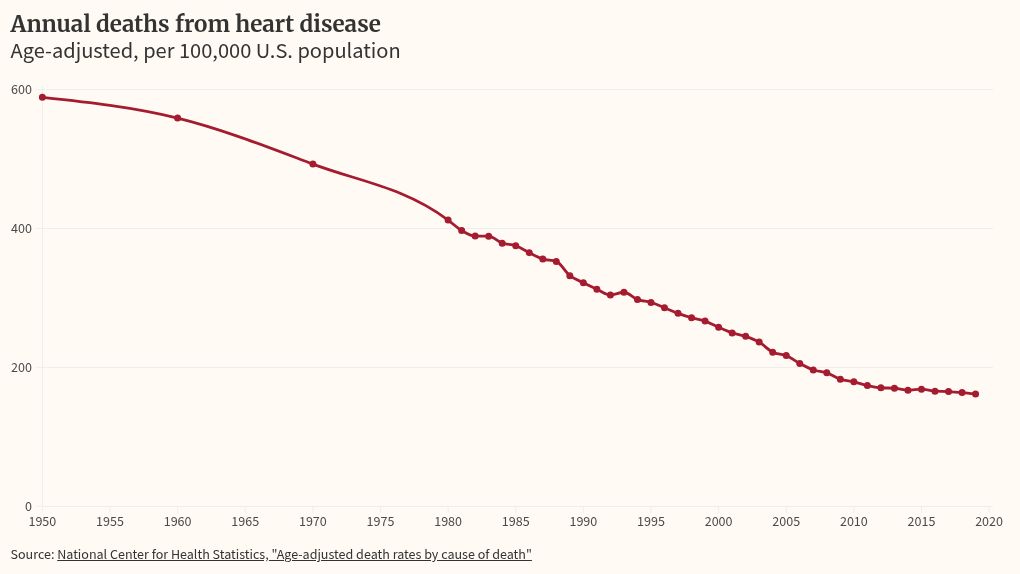
In his book, Same as Ever, finance author Morgan Housel makes the point that most progress is slow and incremental and follows the path of compounding returns over time. He uses an excellent example of heart disease. Deaths from heart disease have been reduced by 1-2% per year since the 1950s.. This has led to millions of lives saved. As he says, “equivalent to saving a major city’s population every year”.
As software engineers, we are familiar with the big leaps in our industries: the web, web2.0, the iPhone, NoSQL databases, cloud platforms like AWS, improved frontend libraries like React, comprehensive development frameworks like Ruby on Rails.
Some of these have created large shifts in how we work. However, the reality is most software products follow a compounding growth pattern: Software that improves over time will win out over software that is big and splashy but short-term focused.
Think about Google Maps for a second. The initial version of Google Maps was impressive but lacked many of the features that people take for granted today: navigation on mobile devices, reviews, restaurant menus, and personalized results. We’re way beyond that initial version now. Twenty years on, Google has continued to enhance this product with gradual and incremental updates. The progress is so slow and steady that most of the time we don’t even notice they’re rolling out new changes. We just use them.
Early in most of our careers, we attended a few hackathons. We saw that in one night an engineer could pull together a piece of software that seemed to push the boundaries of technology. It might’ve been a hobby app that just solved a very specific problem, but being able to build it in one night was impressive!
With AI, over the next few years, the hackathon will become a nostalgic relic of the past. It will be like geeky college kids playing a computer game on a LAN before online gaming was ubiquitous. AI is already able to build in a few minutes the kinds of apps that used to take us all evening to code at those hackathons.
But reality check is, we should not be impressed by this. Because doing an initial version of a product is always the easiest part. Success comes from steady, gradual improvements: engaging stakeholders, testing market concepts, identifying the ideal customer, and adapting products for customers who are willing to take out their credit card and buy it. These are the real struggles for software teams and companies seeking to make money in the software space. Spitting out lines of code that can be demoed to an exec the next day is usually not a signal that points to long-term success.
For software teams, the problem is more subtle than it appears. As teams get addicted to delivering big, splashy things very quickly with AI, the fast pace creates risk of burnout. The could sacrifice the discipline to the slow, grindy work it takes not to move a product from zero to one, but from 1.0 to 1.1, from 1.1 to 1.2, and beyond. This is the work required to keep growing the customer base and to keep delivering small features that hook additional users but don’t make headlines in an org.
So, if you’re a developer today, you should commit to using AI wherever possible, but you also shouldn’t lose sight of the fact that slow and steady can win the race. We shouldn’t discard wisdom gained: that a self‑organized team with continuous learning, strong discipline, good communication, and clear goals will probably beat a disorganized team that has the best AI at its fingertips.